THE SMOKE FROM THE CANADIAN WILDFIRES REACHES SPAIN
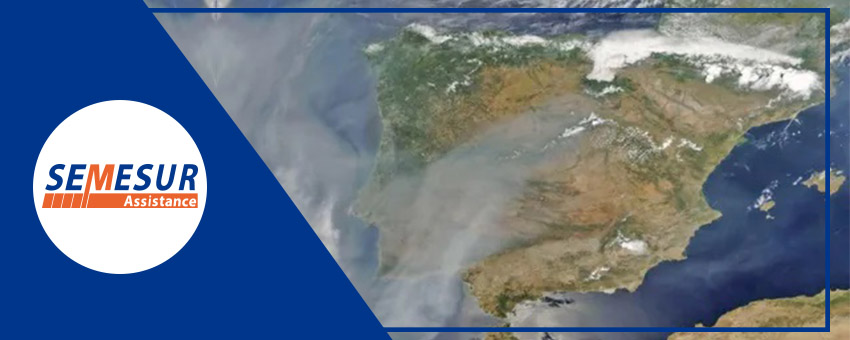
In recent years, wildfires have become an increasingly frequent and devastating challenge in different parts of the world. Canada, known for its vast forested areas, has experienced a significant increase in wildfire activity in recent years. These fires not only have local and regional impacts but can also have large-scale consequences, such as the spread of smoke and pollutant particles over long distances. In this context, Spain has recently experienced the arrival of smoke from wildfires in Canada, raising concerns about public health and the need to take preventive measures.
THE PHENOMENON OF TRANSBOUNDARY SMOKE
Wildfire smoke contains a variety of atmospheric pollutants, including fine particles (PM2.5), volatile organic compounds (VOCs), nitrogen oxides (NOx) and sulphur dioxide (SO₂). These pollutants can travel long distances carried by winds and affect air quality in regions far from the original fires. In the case of Spain, high-altitude winds have transported smoke from Canadian wildfires across the Atlantic, reaching the Iberian Peninsula and the Canary Islands.
IMPACT ON HEALTH
Long-term exposure to fine particles and other pollutants present in wildfire smoke can have significant negative effects on human health. Fine particles can penetrate deep into the lungs and cause or worsen respiratory problems, such as asthma, chronic bronchitis and cardiovascular diseases. In addition, wildfire smoke can irritate the eyes, nose and throat, causing discomfort and making breathing more difficult.
PUBLIC HEALTH RECOMMENDATIONS
Following the arrival of smoke from Canadian wildfires in Spain, health authorities have issued recommendations to minimise health risks for the population. Some of these recommendations include:
Stay informed: Keep up to date with air quality reports and forecasts provided by local and national authorities.
Limit exposure: Avoid outdoor activities that involve intense physical effort, such as running or practising sports, especially for people with pre-existing respiratory conditions, children and older adults.
Protect yourself: Use appropriate masks or respirators when necessary, especially in areas with high concentrations of smoke.
Stay indoors: Whenever possible, remain indoors with doors and windows closed to reduce exposure to smoke.
Improve indoor air quality: Use air purifiers or air conditioning systems with suitable filters to reduce the concentration of airborne particles.
Do you need medical assistance now?
Our team is available 24 hours a day, 365 days a year to assist you.
(+34) 91 10 10 900