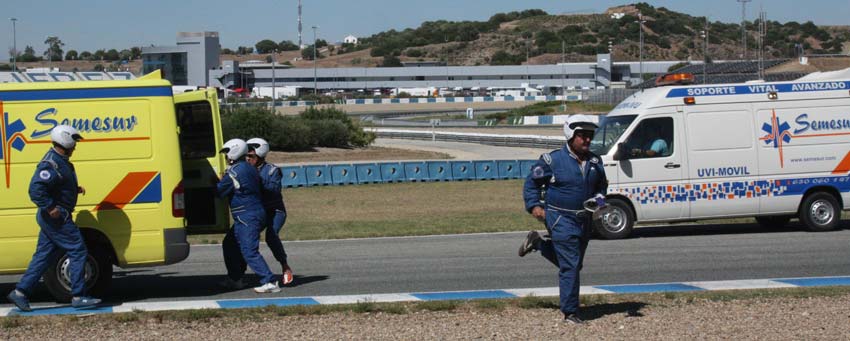
Semesur Assistance deploys extensive human and technical resources to provide first-class medical coverage at the Circuito de Jerez.
The Red Bull Spanish Grand Prix, held at the Circuito de Jerez, is one of Spain's premier sporting events. Every year, nearly 200,000 spectators gather at one of the world's most iconic racing circuits to watch the fastest riders compete during a weekend filled with excitement, entertainment, sunshine, and a shared passion for motorcycle racing.
Behind the scenes, Semesur Assistance is responsible for ensuring the highest standard of medical care for both riders and spectators. To achieve this, we deploy an extensive medical operation involving more than 150 healthcare professionals and approximately 20 emergency vehicles.
Track Medical Coverage
The medical operation is divided into two independent teams. The first consists of around 90 healthcare professionals dedicated exclusively to the sporting event and operating directly on the race circuit.
This team is coordinated by the Circuit Medical Director from Race Control and is centred around a fully equipped Medical Centre staffed by specialists including anaesthetists, intensive care physicians, trauma surgeons, general surgeons, radiologists, nurses, and healthcare assistants. Equipped with advanced medical technology, the centre's primary mission is to stabilise any rider who suffers a serious accident before further treatment or transfer.
In addition to the Medical Centre, 24 intervention teams are strategically positioned around the circuit:
-
10 ambulances, including Mobile Intensive Care Units (MICUs) and Basic Life Support (BLS) ambulances, each staffed by a physician, nurse, and emergency medical technician.
-
14 Ground Posts, each consisting of one nurse and two paramedics.
Their role is to respond immediately to incidents, safely evacuate injured riders from the track, and transfer them to the Medical Centre for further treatment.
A rapid response ambulance is also deployed as a reserve unit, allowing immediate reinforcement anywhere on the circuit during multiple-rider incidents or whenever another ambulance is already engaged.
In addition, Dorna Sports, the MotoGP World Championship promoter, provides two high-performance BMW intervention vehicles, each driven by a former professional rider. Travelling in these vehicles are a Semesur intensive care physician and an emergency nurse equipped with everything required to perform Advanced Life Support (ALS) and advanced cardiopulmonary resuscitation directly at the scene of a serious accident before the rider is transported.
The track operation is completed by a mobile medical team consisting of one physician and one nurse carrying advanced resuscitation equipment, patrolling the pit lane and paddock areas to provide immediate care until an ambulance arrives.
Spectator Medical Coverage
A completely separate medical operation is dedicated to spectators attending the event.
As attendance increases throughout the race weekend, so does the size of the medical team. Approximately 40 healthcare professionals are deployed on the first day, 50 on the second, and around 60 on race day.
These professionals are distributed among five medical stations located throughout the spectator areas.
Two of these stations provide Advanced Life Support (ALS) and are staffed by physicians, nurses, and healthcare assistants, with one also including an intensive care specialist. The remaining three stations provide Basic Life Support (BLS) services.
Healthcare assistants are also positioned throughout the grandstands to provide immediate first aid while ambulances are en route.
The spectator medical fleet includes both Mobile Intensive Care Units and Basic Life Support ambulances, similar to those used for track coverage.
Semesur Assistance also deploys a rapid response motorcycle ridden by an emergency nurse carrying Advanced Life Support equipment. This allows immediate access to locations that may be difficult for ambulances to reach quickly.
If a rider requires transport to hospital, a medical helicopter is available for rapid evacuation. In the case of spectators, helicopter transfers are carried out by the regional emergency medical service (061).
Central Coordination
Two members of the Semesur Assistance team remain permanently stationed at the Advanced Command Post, working alongside representatives from all emergency and security agencies involved in the event, including the Guardia Civil, Local Police, National Police, Spanish Red Cross, 112 Emergency Services, and 061 Emergency Medical Services.
From this command centre, every medical and safety incident is coordinated to ensure the fastest and most effective response possible.
Preparation and Experience
To guarantee seamless operations, the Semesur Assistance team participates in all pre-event safety meetings and undergoes several months of specialised preparation. Training includes protocol workshops, simulation exercises, and operational planning sessions specifically designed for the demands of the MotoGP event.
Thanks to many years of experience covering the Spanish Grand Prix and other major international sporting events, Semesur Assistance has developed the expertise required to design and deliver medical operations of this scale anywhere in the world.